Monday, November 17, 2008

'Awakening Possibilities'


Consider this your official invitation to attend 'Awakening Possibilities', a live event being held in Winnipeg, Canada the evening of November 27th, 2008. I've been pouring a lot of time and energy into putting together this event as a follow-up to last year's MB Edubloggercon, which was sponsored by ManACE. Not only do we want to see you there, but we also want you to help us spread the word about 'Awakening Possibilities', so please share the following .pdf wherever you see fit - print in out and hang it in your staffroom, e-mail it to a friend, or post it on your blog or wiki -

'Awakening Possibilities' will feature short presentations by many prominent edubloggers. We'll hear from Darren Kuropatwa, Clarence Fisher, Chris Harbeck and John Evans, all of whom will be in attendance. We'll also hear from Alec Couros, Kathy Cassidy, Jeff Utecht and Dean Shareski, all of whom will be presenting virtually at 'Awakening Possibilities'.

We'd love to have you join us for 'Awakening Possibilities'. If you'll be anywhere near Winnipeg on November 27th, 2008, send me an e-mail to get involved - andy@mckiel.ca

Of course, no matter where you are, you can participate online. To find out more about this event, please visit the 'Awakening Possibilities' wiki.

I hope to see you there :-)
Andy

Tuesday, November 11, 2008

The Incredible Journey

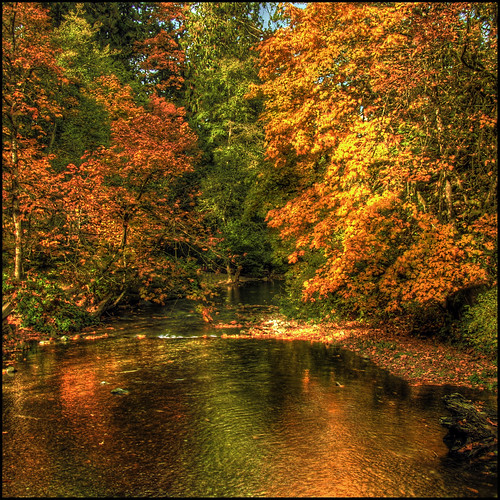
Image: 'Goldstream River' - www.flickr.com/photos/41864721@N00/2998189077

I have traveled out to Vancouver Island at least twenty times and there are many things that I love about the island. I've spent the last twenty years living in the prairies, but I'm not prairie born or bred, so I'm drawn to the mountains and the ocean. I love to get out on the water, sit on the beach and watch the waves roll in, and go for hikes to discover the panoramic vistas that await.

I've finally accomplished one of my longest-standing goals when visiting Vancouver Island - witnessing the salmon run. Typically, I only get to the island during the summer months or over the winter break, so the timing is off. Therefore, when I was invited to attend a November conference in Vancouver, I planned to hop onto the ferry and attempt to catch the coho as they trekked upstream.

For those of you who have witnessed the salmon run firsthand, I'm sure you'd agree that it is an awe-inspiring experience. They fight so hard to make progress up the river, knowing full well that once they reach their destination, they've truly reached the end of their journey.

I tried to capture the essence of the salmon run in the following video. While it is impossible to bring this experience to life without witnessing it firsthand, this video should give you an idea of the scope and magnitude of the challenges that the coho salmon face as they push onward and upward... enjoy :-)

The Salmon Run

Thursday, November 6, 2008

Futility


Over the last few days, I've felt like banging my head against the wall on more than one occasion. The hotel where my conference is being held, and where I've spent the last couple of nights, claims to offer wireless Internet access to all of it's guests. The picture above captures the essence of the quality of their wireless access - a snapshot of a 3.3 MB download that still requires 18 minutes to complete...

I guess I've just become used to connecting to the internet at much faster speeds than this, because I feel so restricted by ridiculously slow connection speeds. Although my connection almost never times out, it is painfully slow even for menial tasks like loading flash-free webpages.

Last night, I almost went off on a little rant about this issue, when it took me 40 minutes to attach a 2 MB file to an e-mail that had to be sent. I was prepared to question whether the hotel even had the right to call this access. But I'm glad I caught myself, because I was reminded of the fact that for many people around the globe, access doesn't come any better than this. I sometimes take it for granted that the fast reliable access that I have day in and day out is an experience shared by all, which certainly isn't the case.

As frustrating as this can be, it pays to remember that slow access is far superior to no access...

Wednesday, November 5, 2008

Down By The Bay... follow me :-)

I've been in Vancouver for the last couple of days for some SMART sessions, and I wanted to get out and see some of the sights around town. I decided to go for a 'little' walk - almost seven hours of meandering around Vancouver's vibrant streets and serene sea walls.

I've embedded my adventures from last evening into the following Google Map. Take a closer look at some of the great views along the way :-)

All Around Town


View Larger Map

There's no better way to learn a city than to get lost in it's streets and rivers.
Hope you've enjoyed my adventures :-)

Monday, October 27, 2008

Five Minutes to make a difference.

Image: 'cinderella' - www.flickr.com/photos/14784969@N08/2580895303

In this day and age, time is of the essence.

Every day, I'm forced to consider how to make the best use of my time. I like to think that I manage my time fairly wisely. However, I always find I end up a few minutes short when it comes to having enough time to accomplish all of my daily goals. There just isn't enough time in the day. As much as Merlin Mann's 43 Folders blog helps me along with my efficiency and productivity, I still find I could use just a few more minutes each day...

This is a common complaint I hear from the teachers with whom I work - time is of the essence. Too many teachers shy away from emerging technologies and web tools because they feel that they just don't have the time. They don't see the fact that many of these tools can increase their productivity and lead them toward more creative and innovative ways to reach their goals and objectives.

How much of a difference could five more minutes make? This is an idea I've been pondering for some time now. I think it was probably triggered by a comment that Darren Kuropatwa made in one of the first K12 Online Conference podcasts released earlier this year. Darren mentioned a presentation he was asked to give for the administrators in his division. He was given five minutes to share his knowledge of blogging. Darren's first thought was that five minutes wasn't even enough time for a proper introduction - what more could be shared in only five minutes? But the longer he thought about it, the more he realized that it is possible to pack a wealth of information into only five minutes.

You can make a big difference with only five minutes - just watch Chris Lehmann's ignitePhilly presentation for proof of this:


Look at the growing popularity of TED Talks and all of the many steaming video services afforded by the web. YouTube is single-handedly changing our media viewing habits because we all crave what it has to offer - and we feel that we can spare a few minutes here and there much more easily than committing ourselves to a task that's much longer in duration.

If you had five minutes to make a difference, what would you do with it?

Five minutes to make a difference.
That's all I want...


Thanks for reading,
Andy

Thursday, October 16, 2008

When Your Hands Are Tied...

Image: 'Gassa d'amante' - www.flickr.com/photos/11779957@N07/2521208486

Wouldn't the world be a much easier place to live if you always had the power and ability to control situations that are sometimes beyond your control?

For example, filtering web content.

Divisional web filtering solutions can sometimes pose such barriers to us as educators. While I fully appreciate the need to limit the access students have to some of the virtual trash that the Internet houses, I think we're shooting ourselves in the foot by blocking everything that may pose a risk to our students.

We strive to teach our students all about the ethical and responsible use of technology. In doing so, we discuss some of the dangers associated with sharing private information. We work with our students to help them understand that their online actions leave a permanent mark. We encourage our students to show the same level of respect for their online acquaintances as they would with their off-line peers.

When it comes to accessing online content, we tend to tighten the leash on our students and deny them access to some valuable resources. Many divisions block YouTube content. Twitter use isn't allowed by a number of the divisions in my province. In fact, in many divisions, access to a number of the free and useful online tools that pop up each day will be blocked by the time these tools become mainstream.

Why do divisions/districts feel such a strong need to restrict access to this content? Is it for the sake of the students or are we filtering this content from the teachers? If it's because we don't want our students to stumble upon content that may not be appropriate for them, we're really wasting our time. In most developed and developing regions, students have more access to technology at home than they do at school. And too many parents don't pay close enough attention to how their children use technology at home. If a student wants to access inappropriate material online they will, whether they do it at school or at home.

If we had open access to the good and the bad in all of our schools, I think it would empower teachers to engage their students in more discussions about the ethical and responsible use of technology. Sure, allowing our students to visit YouTube may result in a few minutes of wasted time, but it could also generate some great discussions, motivate reluctant learners, and encourage a great deal of collaboration. I get jealous when I read Clarence's posts about his students uploading videos to YouTube, because I know that many of the teachers in my division would love to do this with their students, but their hands are tied :-(

Although it's frustrating when our hands are tied, bringing more people into the fray may help to loosen the knots.

Here's hoping...


Tuesday, October 7, 2008

The Smallest Footprint

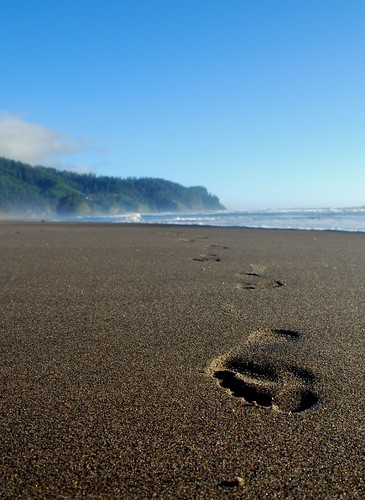
Image: 'We've come this far.' - www.flickr.com/photos/79105258@N00/737263197

Sustainability has become a very relevant issue in many of our lives today. With the exponential growth evident in all aspects of society today, there is an increasing need to take stock of the effect our species is having on the environment.

The threat that we are depleting our natural resources is not new. The fact that we are wasting many of our 'renewable' resources has been evident for decades. Al Gore's An Inconvenient Truth shed much light on this issue a couple of years ago. More recently, The Story of Stuff opened our eyes to the amount of waste we create and showed us some of the errors of our ways. But the fact remains that the destruction of our planet is still continuing at an alarming rate and little is being done to stop it.

Last Friday, my school division had the insight to invite Dr. David Suzuki to speak to us via video-conference from British Columbia. Dr. Suzuki has long been an advocate of the environment and he has fought hard for many years to preserve our natural surroundings. According to Suzuki, the peril of the environment is imminent and we must act now to save the environment. We must all strive to do our bit to protect and preserve nature in it's truest form. And right now, the key to having a voice on this matter is to raise the issue of environmental activism with our political candidates. The fate of our nation rests in our hands and on October 14th, that fate will be determined for the next several years. What happens to the environment really isn't our problem. It's a problem that we're passing on to our kids and our grandkids. It's not enough to simply teach our kids about these problems and offer solutions. We must act on behalf of our children. They don't have a voice when it comes to voting - our children need us to act on their behalf.

As we move forward as a country and look to the future of our government, we must ensure that the party that's voted into power in Canada will do their part. Rather than passively observing and documenting all of the ill-effects that our planet is suffering, they must take a stand and act now. We must all take it upon ourselves to raise the issue of the environment and question our candidates in this regard. How are they prepared to act if they get elected?

We've heard all of this before, but what have we done about it?

What have you, personally, done about it?

I feel very strongly that technology holds the key to solving a lot of our sustainability issues. Technology is responsible for giving us the big picture in terms of what's happening on a global level. Rather than focusing on smaller community challenges and solutions, we can act on a much larger scale. Technology brings us together in such a way that we really can work collaboratively and find solutions to the problems that are affecting us the world over.

For the benefit of our planet, we must focus on reducing our 'footprint' on the earth. We have to move towards more sustainable practices, and we must help others to do the same.

As one person, what are you prepared to do in order to leave the smallest footprint?

For those of you who would like to hear Dr. David Suzuki share some of his views of what he would do if he were elected as our Prime Minister, check out this audio podcast, recorded at Queen's University last year: